
 EN
EN
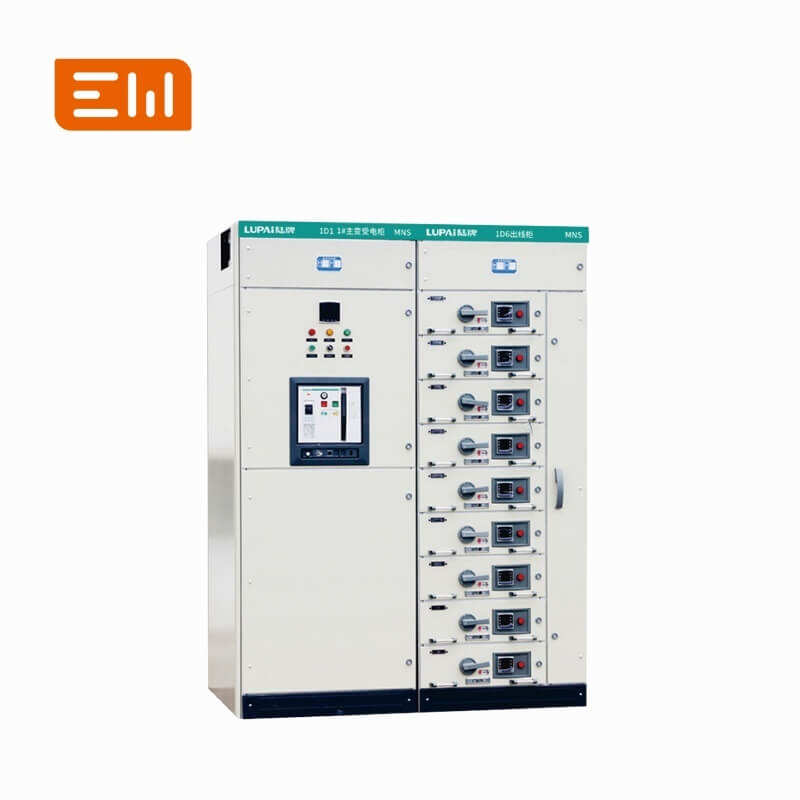
Low Voltage Switchboard: Design, Ratings, and Selection Guide
Introduction
Low voltage switchboards distribute power to panels, MCCs, and critical loads in commercial and industrial sites. Correctly sizing busbars, interrupting ratings, and protective devices prevents downtime and improves safety.
Overview and Working Principle
- Role: Receives power from transformers or generators and feeds downstream feeders and panels.
- Interruption: Air or molded-case breakers clear faults; selective coordination reduces outage scope.
- Structure: Form-of-separation options and segregated bus/cable sections improve safety and maintenance access.
Technical Features and Ratings
- Voltage class: Typically 400–690 V systems.
- Busbar rating: 1600–6300 A depending on load density; consider temperature rise and ambient.
- Short-circuit withstand: kA rating must exceed available fault current with margin; verify bracing and tested assemblies.
- Standards: IEC 61439 (or UL 1558/891 in North America) define construction, clearances, and testing.
- Protection devices: ACBs/MCCBs with adjustable trip units (LSIG), ground fault sensing, and zone-selective interlocking.
- Metering and comms: Digital meters with Modbus/IEC 61850 options for energy and power quality.
Sizing and Coordination
- Fault current study: Calculate available fault at the main and downstream feeders; choose breakers with adequate Icu/Ics and bus bracing.
- Selective coordination: Use time-current curves or ZSI between mains, ties, and feeders to limit outages.
- Thermal design: Account for diversity, harmonics, and ambient temperature; consider derating for enclosed or hot rooms.
- Arc-flash reduction: Maintenance mode settings, fast ground fault clearing, and compartmentalization lower incident energy.
- Ingress protection: Choose IP/Type rating suitable for dust, moisture, or corrosive atmospheres; add space heaters where needed.
Applications
- Commercial buildings and hospitals: Reliable mains and tie sections, generator integration, and metering for billing and ESG reporting.
- Data centers: High-density busbars, sectionalized mains, and ZSI to maintain uptime.
- Industrial plants: Robust bracing for high fault levels; integration with MCCs and process loads.
- Renewables and storage: Switchboards interfacing inverters, BESS, and utility interconnection with proper protection.
Safety and Maintenance
- Apply IR windows and temperature monitoring on mains and bus joints.
- Maintain torque on bus connections and lugs; inspect for discoloration.
- Test trip units and ground fault systems periodically; keep updated coordination files.
- Label arc-flash boundaries and PPE categories based on the latest study.
Why Choose Enwei Electric
Enwei Electric manufactures LV switchboards built to IEC 61439 with tested bus systems, configurable form-of-separation, ZSI-capable trip units, and integrated metering. Explore Enwei LV switchgear for technical details and project support.
Conclusion
A well-engineered LV switchboard aligns bus ratings, fault duty, coordination, and safety features to protect people and equipment. Engage Enwei Electric to review your studies and finalize a switchboard that matches load density, reliability goals, and local codes.
Image Suggestions
- Image: https://www.enweielectric.com/products/switchgear ALT: "Low voltage switchboard by Enwei Electric"