
 EN
EN
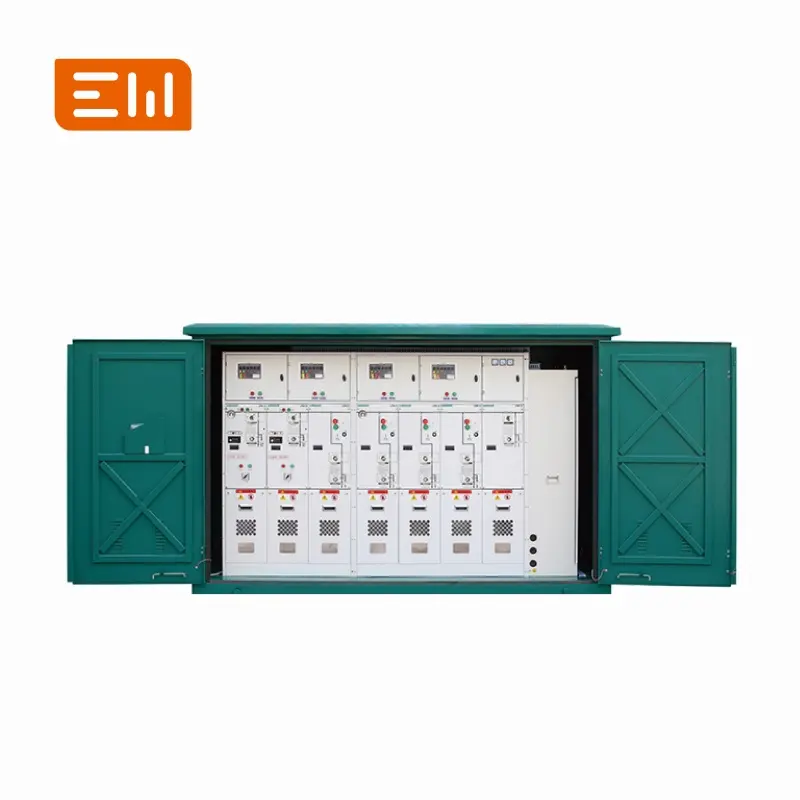
Typical RMU Protection Schemes: LBS-Fuse, CB + Relay, and Feeder Automation
RMUs are often described as “switching” devices, but protection decisions determine how well an RMU actually limits damage and restores service during faults. The most common RMU protection schemes fall into three buckets: load break switch + fuse, circuit breaker + relay, and automation-ready feeder designs.
This article outlines how each scheme works, where it fits, and the specification items you should align before procurement.
Scheme 1: Load Break Switch (LBS) + Fuse for Transformer Feeders
This is one of the most widely used transformer feeder schemes in distribution RMUs. The ring feeders are typically LBS ways, and the transformer feeder uses a fused switch.
How it protects: the fuse clears short-circuit faults on the transformer or LV side reflected to MV, while the LBS provides switching and isolation capability.
Best-fit applications:
- Standard distribution transformers with conventional protection needs.
- Sites prioritizing simplicity and low lifecycle complexity.
- Networks where relay coordination is not required at each kiosk.
What to specify: fuse type and rating approach, striker operation requirements, indication, and safe replacement procedures.
Scheme 2: Vacuum Circuit Breaker (VCB) + Protection Relay
Breaker-based RMUs are used when protection coordination, automation, or higher duty is required. The breaker feeder uses CTs and a relay to trip on faults.
How it protects: relay functions (overcurrent, earth fault, directional where needed) trip the breaker quickly. Protection settings can be tuned for coordination and selectivity.
Best-fit applications:
- Critical loads or industrial feeders needing selectivity and remote control.
- Higher fault-level networks where fused schemes are not preferred.
- Projects with SCADA integration and remote restoration requirements.
What to specify: CT ratios and classes, relay functions, trip coil/control voltage, and event recording requirements.
Scheme 3: Automation-Ready RMU (FPI + Motorization + Remote IO)
Feeder automation is not only about a breaker. Many utilities deploy automation-ready RMUs with:
- Fault passage indicators (FPI): to locate faults quickly in cable networks.
- Motorized LBS: remote switching for sectionalizing.
- Remote terminal unit (RTU) IO: status, alarms, and control.
How it helps: by reducing fault location time and enabling remote restoration, especially in ring networks with multiple kiosks.
What to specify: communication interface expectations, control power strategy, IO list, and cybersecurity requirements if applicable.
Earth Fault Protection Considerations
Earth fault behavior depends on system grounding (solid, resistance, isolated). Your protection scheme must match the network earthing method. For example:
- Solidly grounded systems can use conventional earth-fault overcurrent thresholds.
- Resistance grounded systems may require sensitivity adjustments.
- Isolated or compensated systems often need directional earth-fault protection and careful coordination.
Include the earthing method in your RMU RFQ; without it, protection assumptions will diverge.
Procurement Checklist for RMU Protection
- Single-line diagram: number of ring ways, transformer feeder type, and any additional feeders.
- Network data: short-circuit level at the kiosk, grounding method, and coordination expectations.
- Automation scope: manual only vs motorized; local only vs SCADA.
- Measurement needs: metering CT/VT requirements if billing or monitoring is needed.
- Test requirements: FAT items, functional testing for interlocks and IO.
Internal Links
For RMU product categories and configuration discussions: Ring Main Units.
For MV protection devices in general and related assemblies: Switchgear.
Conclusion
There is no single “best” RMU protection scheme. LBS + fuse is simple and proven for many transformer feeders. Breaker + relay enables selectivity and automation. Automation-ready RMUs reduce outage time by improving fault location and remote restoration. Choose based on fault level, grounding method, criticality of loads, and the operational model of the network.
Image Suggestions
- Image: https://www.enweielectric.com/products/rmu
- ALT: "RMU protection schemes for transformer feeders and ring feeders"
- Image: https://www.enweielectric.com/products/current-transformers
- ALT: "Current transformers used for RMU protection relay measurements"
Table of Contents
- Typical RMU Protection Schemes: LBS-Fuse, CB + Relay, and Feeder Automation
- Scheme 1: Load Break Switch (LBS) + Fuse for Transformer Feeders
- Scheme 2: Vacuum Circuit Breaker (VCB) + Protection Relay
- Scheme 3: Automation-Ready RMU (FPI + Motorization + Remote IO)
- Earth Fault Protection Considerations
- Procurement Checklist for RMU Protection
- Internal Links
- Conclusion
- Image Suggestions